Thursday, July 17, 2008

Honey eliminates stubborn skin microbes

Medical grade honey may be used to prevent or treat infections of skin, burns, catheters and other skin-penetrating medical devices.

Medical grade honey kills antibiotic-resistant bacteria grown in the test tube and eradicates antibiotic-resistant bacteria "colonies" on the skin of healthy volunteers, Dutch researchers report.

honey 2

Given these findings, senior investigator Dr Sebastian A.J. Zaat said, "Medical grade honey might be used to prevent or treat infections of skin, burns, catheters and other skin-penetrating medical devices."

Honey, they point out, has been used since ancient times to successfully treat infected wounds. Moreover, there have been no reports of antibiotic resistance to honey.

However, large variation in the antibacterial property of various honeys has hampered current medical acceptance.

To investigate further, the researchers tested the antibacterial activity of the medical grade honey called Revamil (Bfactory), which is produced in greenhouses under standardised conditions.

They found that antibiotic-susceptible and antibiotic-resistant isolates of several common bacteria, including Staphylococcus aureus and E. coli, were killed within 24 hours after incubation with the honey.

They also found that the honey decreases the ability of these microbes to "colonise" the skin of healthy volunteers.

After applying honey for 48 hours to "bacteria-laden" patches of forearm skin, the extent of skin colonisation was reduced 100-fold.

Moreover, 81 per cent of the honey-treated skin patches yielded negative skin culture results compared to 21 per cent of control patches.

Following these encouraging results, continued Zaat, "We are presently investigating whether honey can be used to prevent line sepsis in intensive care patients. This potentially life - threatening infection is often caused by bacteria from the skin, which can be eradicated with honey."

Source:Mindfood

Monday, July 14, 2008

Red Wine can Protect People from Microbes

Wine lovers have one more reason to cheer. A US study reveals that drinking red wine and red grape juice may protect people from common food-borne illnesses.

The findings were recently presented at the Institute of Food Technologists annual conference in Chicago. Researchers at the University of Missouri-Columbia conducted studies in which they examined the effects of reseveratrol — the compound responsible for wine's red colouring — as well as ethanol and pH levels on common food pathogens such as E. coli, Salmonella typhimurium, Listeria monocytogenes and H. pylori.

They discovered that in addition to ethanol, reseveratrol and pH may inhibit the pathogens.  In the study, Cabernet, Zinfandel and Merlot wines were found to be particularly effective in defending against food-borne pathogens and had high anti-microbial properties.

Red wine

Yet the wines didn't have a negative effect on probiotic bacteria, which fight harmful bacteria in the intestines."This study showed that the four probiotics tested weren't inhibited by red wines; the pathogens were," said Azlin Mustapha, associate professor of food science at the University of Missouri-Columbia.

Numerous white wines also were tested, but yielded no positive results, the researchers said. "It's not just ethanol in the red wine that is inhibitory toward food-borne pathogens, but other factors which include the pH of the wine — because wines are a little acidic, and possibly the phytochemicals may have an effect," said Mustapha, noting that grape juice produces similar results.

"We hypothesize that these phytochemicals, reseveratrol being the main one, also play a role not just as antioxidants but also may have some inhibitions against food-borne pathogens."

Source: medindia.com

Friday, July 11, 2008

Rust-Breathing Bacteria: Miracle Microbes

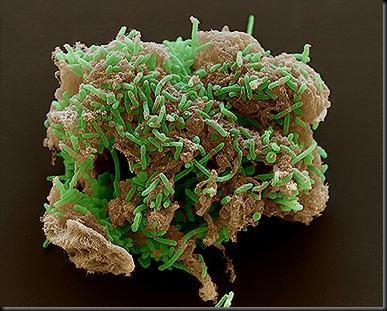
They breathe rust, clean up polluted groundwater, generate electricity, and may harbor clues to the origins of life. That's a lot for one family of microscopic bugs, but don't be surprised when Derek Lovley wows the world with another wonder from the Geobacter genus of bacteria.

"When we think we have hit the last of the big discoveries, something else comes along," said Lovley, a microbiologist at the University of Massachusetts, Amherst.

The microbes' metabolism is unique: They use metals to get energy from food in the same way humans use oxygen. In 1987 Lovley discovered Geobacter metallreducens in some iron-rich mud he scooped up from the Potomac River.
Geobacter

In the 17 years since that discovery, Lovley and his colleagues have found more than 30 species in the bug family, sequenced the genomes of several, and filled scientific journals with the details of new insights.

Lovley collaborates with scientists around the world, and his lab buzzes with more than 50 researchers. Most recently, Lovley and his colleagues sequenced the genome of a Geobacter species that can generate electricity and cleanup groundwater contaminated with uranium.

"Never underestimate the abilities of the microbial world," said Tim Magnuson, a microbiologist who worked in Lovley's lab before moving to Idaho State University in Pocatello.

Magnuson believes that the Geobacter species and a number of other metal-reducing bacteria discovered since Lovley's seminal 1987 find are the just the beginning of what promises to be an exciting scientific journey into the world or microbes with unique metabolisms.

"The more we look, the more we discover. We have and will discover organisms that are not at all related to Geobacter but can carry out that kind of metabolism. It is a huge frontier."

Lovley Bugs

When Lovley embarked on his academic journey into the sciences, all he wanted to find was a good job in the outdoors. But as he pondered what made the world go around as an undergraduate biology major at the University of Connecticut in the 1970s, things began to change.

"It started to be apparent that these microorganisms account for a lot of biomass [living matter] on Earth and are big drivers for the environmental and ecological processes," Lovley said. "So I went to grad school and tried to learn microbiology."

After receiving his Ph.D. from Michigan State University in 1982, Lovley took a job with the United States Geological Survey studying how microorganisms affected groundwater in the Chesapeake Bay.

He knew that microorganisms could live in oxygen-deprived environments by processing things such as sulfate and methane. If they could do that, Lovely reasoned, they might also be able to make a living from iron. Which is why, in 1987, Lovely scooped up the iron-rich mud from the Potomac River just downstream from Washington, D.C. Unbeknownst to him, the microbes therein would change his life.

Back in his lab, Lovley put the mud in a test tube, added some acetate—essentially vinegar, a favorite microbe food—and watched. Eventually, he noticed little black minerals collecting on the bottom of the tube amidst a sea of fluffy orange iron oxide, or rust.

"I put a magnet up to the side of the tube, and all the little pieces flew over to the side of the glass," Lovely said. "That was a 'Eureka!' moment."

The mud-dwelling microbes, which Lovley later named Geobacter metallreducens, obtained their energy by transferring electrons onto the rust. In the process, they turned the rust into magnetite.

Magnetite is the source of most of the magnetic material deposited on Earth some two billion years ago. Lovley and his colleagues concluded in a 1987 paper published in Nature that the microbes may have been responsible for most of these early magnetite deposits.

Microbes in Action

Since Geobacter metallreducens was discovered, Lovley and his colleagues have tried to figure out how to take advantage of this unique microbial metabolism, from cleaning up contaminated groundwater to generating electricity.

Magnuson, the Idaho State University microbiologist, believes that the ability of microorganisms like Geobacter to clean up groundwater may be of particular use to humans in the coming decades, as world populations are predicted to experience a water crisis.

He envisions using microbes not only to decontaminate water supplies but to protect them until human consumption.

"Using Geobacter to protect and maintain the quality of these aquifers might be a viable solution, seeing as we are going to run into water-quality issues," he said.

Lovley and his colleagues are not yet developing Magnuson's proposed superefficient water filters, but they are actively developing a method to remove uranium from billions of gallons of contaminated groundwater.

Source:National geographic

Thursday, July 10, 2008

Scientists discover way to protect against death following plague infection

Bacteria that cause pneumonic plague can evade our first-line defences, making it difficult for the body to fight infection. In fact, a signature of the plague is the lack of an inflammatory response.

Now, scientists have discovered a way to protect against death following infection with plague bacteria, by using molecules that can mimic the pathogens. According to research published in the July issue of Microbiology, these molecules make antibiotics more effective and can even be used to protect against other diseases.

The plague, caused by Yersinia pestis, has killed an estimated 200 million people worldwide. Although treatments have improved, it remains a threat to public health. It can be transmitted from human to human in aerosols and is therefore listed as a Category A bioterrorism agent.

Yersinia pestis

"Yersinia pestis is successful in causing disease in mammals because it can dampen the normal non-specific immune response to infection," said Dr Scott Minnich from the University of Idaho, USA. "We found an intranasal therapy that stimulates the innate immune response and protects against pneumonic plague."

Following infection, lipid A (which is part of the bacterial surface) binds to receptors on our immune cells, triggering an immune response. Yersinia pestis circumvents this, stopping our cells from taking action. Molecules have been developed that mimic lipid A, eliciting a strong immune response that can prevent death in infected animals. Dr Minnich and his colleagues studied the effect of a nasal spray containing two such molecules, CRX-524 and CRX-527, on mice infected with Yersinia pestis.

"Treatment with synthetic modified lipid A molecules can directly protect animals against pneumonic plague infections," said Dr Minnich. "We also found that stimulating innate immunity using this nasal spray enhanced conventional antibiotic therapy. When it is given along with antibiotics, fewer doses and less antibiotic protects against pneumonic plague."

The results of this study suggest that synthetic modified lipid A compounds may provide a new therapeutic tool against plague infection. In a control group that did not receive the treatment, only 23% of mice survived for 3 days. When given the mimic molecules, up to 93% of mice survived for 3 days, 70% for 4 days and 34% recovered completely. This highlights the importance of the non-specific, first-line immune defences during the critical early phase of infection. Stimulating this response can over-ride a microorganism's counter measures to evade or disable the immune response.

Other studies have shown related therapeutic compounds are also effective against influenza and Listeria monocytogenes. "This work is still at a very basic animal model testing stage with regards to plague," said Dr Minnich. "What is exciting is that these studies provide insight into bacterial/host interactions in the disease process and promise new strategies to combat a variety of infectious agents."

Source: news-medical.net.

Wednesday, July 9, 2008

What Genes Help Microbes Invade Leafy Greens?

When unwanted microbes form an attachment, the consequences—for us—can be serious.

That’s if the microbes happen to be human pathogens like Listeria monocytogenes, if the target of their attentions happens to be fresh vegetables often served raw, such as cabbage or the sprouted seeds of alfalfa.

image

Scientists don’t yet fully understand how the malevolent microbes form colonies that cling stubbornly to and spread across plant surfaces, such as the bumpy leaves of a cabbage or the ultra-fine root hairs of a tender alfalfa sprout.

But food safety researchers at the ARS Western Regional Research Center in Albany, California, are putting together pieces of the pathogen puzzle.

A 1981 food-poisoning incident in Canada, caused by L. monocytogenes in coleslaw, led microbiologist Lisa A. Gorski to study the microbe’s interactions with cabbage. Gorski, with the center’s Produce Safety and Microbiology Research Unit, used advanced techniques not widely available at the time of the cabbage contamination.

“Very little is known about interactions between Listeria and plants,” says Gorski, whose study revealed the genes that Listeria uses during a successful cabbage-patch invasion.

The result was the first-ever documentation of Listeria genes in action on cabbage leaves. Gorski, along with coinvestigator Jeffrey D. Palumbo—now with the center’s Plant Mycotoxin Research Unit—and others, documented the investigation in a 2005 article in Applied and Environmental Microbiology.

Listeria, Behaving Badly

“People had looked at genes that Listeria turns on, or ‘expresses,’ when it’s grown on agar gel in a laboratory,” says Gorski. “But no one had looked at genes that Listeria expresses when it grows on a vegetable.

“We were surprised to find that when invading cabbage, Listeria calls into play some of the same genes routinely used by microbes that are conventionally associated with plants. Listeria is usually thought of as a pathogen of humans. We hadn’t really expected to see it behaving like a traditional, benign inhabitant of a green plant.

“It’s still a relatively new face for Listeria, and requires a whole new way of thinking about it.”

In related work, Gorski is homing in on genetic differences that may explain the widely varying ability of eight different Listeria strains to successfully colonize root hairs of alfalfa sprouts—and to resist being washed off by water.

Source:USDA

Friday, July 4, 2008

New Window Opens On The Secret Life Of Microbes

Nowhere is the principle of "strength in numbers" more apparent than in the collective power of microbes: despite their simplicity, these one-cell organisms--which number about 5 million trillion trillion strong (no, that is not a typo) on Earth--affect virtually every ecological process, from the decay of organic material to the production of oxygen.

But even though microbes essentially rule the Earth, scientists have never before been able to conduct comprehensive studies of microbes and their interactions with one another in their natural habitats. Now, a new study provides the first inventories of microbial capabilities in nine very different types of ecosystems, ranging from coral reefs to deep mines.

new

"These new microbial inventories provide a new and important window into ecosystems and how they respond to stresses, such as pesticide runoff and invasive species," said Lita Proctor, an NSF program director.

Rather than identifying the kinds of microbes that live in each ecosystem, the study catalogued each ecosystem's microbial "know-how," captured in its DNA, for conducting metabolic processes, such as respiration, photosynthesis and cell division. These microbial catalogues are more distinctive than the identities of resident microbes. "Now microbes can be studied by what they can do not who they are," said Proctor.

This microbial study employed the principles of metagenomics, a powerful new method of analysis that characterizes the DNA content of entire communities of organisms rather than individual species. One of the main advantages of metagenomics is that it enables scientists to study microbes--most of which cannot be grown in the laboratory--in their natural habitats.

Specifically, the microbial study produced the following results:

A unique, identifying microbial fingerprint for each of nine different types of ecosystems. Each ecosystem's fingerprint was based on its unique suite of microbial capabilities.

Methods for early detection of ecological responses to environmental stresses. Such methods are based on the principle that "microbes grow faster and so respond to environmental stresses more quickly than do other types of organisms," said Forest Rohwer of San Diego State University, a member of the research team. Because microbes are an ecosystem's first-responders, by monitoring changes in an ecosystem's microbial capabilities, scientists can detect ecological responses to stresses earlier than would otherwise be possible--even before such responses might be visibly apparent in plants or animals, Rohwer said.

Evidence that viruses--which are known to be ten times more abundant than even microbes--serve as gene banks for ecosystems. This evidence includes observations that viruses in the nine ecosystems carried large loads of DNA without using such DNA themselves. Rohwer believes that the viruses probably transfer such excess DNA to bacteria during infections, and thereby pass on "new genetic tricks" to their microbial hosts. The study also indicates that by transporting the DNA to new locations, viruses may serve as important agents in the evolution of microbes.

Source: ScienceDaily

Tuesday, July 1, 2008

Fighting Cancer With Salmonella

Disease-causing bacteria can help in the fight against cancer. This may sound a little far-fetched at first, but in future bacteria could form the basis for innovative tumor therapies. Researchers at the Helmholtz Centre for Infection Research in Braunschweig have succeeded in planting "remote-controlled" salmonella in the tumors of cancer-bearing mice. The genetically modified microbes can produce substances on command. "Perhaps at some point," hopes Helmholtz scientist Dr. Holger Loessner, "we will be able to make these bacteria secrete cell toxins precisely where they are needed: in the middle of cancerous tissue."

fight cancer

Dr. Loessner's hopes are based on a curious phenomenon that researchers have known about since the mid-19th century. When tumor patients encounter a bacterial infection, frequently tumors are colonized by the bacteria and provide a niche for their multiplication. What exactly triggers this behavior is not well understood. "We suspect that the dead tissue inside the tumor provides these bacteria with a protective and nutrient-rich environment, and therefore, attracts them," explains Dr. Siegfried Weiss, head of the project group "Molecular Immunity" at the Helmholtz Centre for Infection Research. "Tumor interiors," he adds, "are low in oxygen, conditions under which many types of bacteria thrive."

For Weiss, Loessner and their colleagues, more important than the basic principles are the possibilities this phenomenon opens up. The rush by bacteria to colonize tumors suggests this behavior could be used for human benefit. Weiss and Loessner have now shown that this is essentially feasible. For the first time, they inserted in bacteria of the genus Salmonella typhimurium, a gene cluster which can be "switched on" by administration of a simple sugar molecule called L-arabinose.

Applying L-arabinose, after the salmonella bacteria have infected mice and migrated to the cancerous tissue, activates these genes. Thus far, Weiss and Loessner used genes that encode light emitting proteins. If the mice are given a dose of the sugar, bacteria that have colonized the tumor fluoresce, such that the location and size of the tumor can be analyzed. Theoretically, instead of emitting light, the bacteria in future could be triggered to produce and deliver cancer-fighting medication inside the tumor.

Alternatively, they could also deliver immune-stimulating substances that would mark the tumor for the body's own immune-defense mechanisms and induce a salutary immune response. "For medical purposes, of course," notes Dr. Loessner, "we would not use dangerous pathogens, but rather mutant strains that are harmless to humans."

"Until now, people have viewed salmonella as a threat to their health," says project leader Weiss, "so there would be a certain charm in using such bacteria for treatment of such a terrible disease as cancer."

Source: Sciencedaily